

How Do Companies Generate Virtual Credit Cards?
Virtual credit cards have become one of the most important innovations in digital payments. Whether you're shopping online, subscribing to a streaming service, managing employee spending, or protecting your financial information, there's a good chance you've already used a virtual card without realizing how much technology works behind the scenes.
Many people assume companies simply "create" a card number and make it work instantly. The reality is much more sophisticated. Every virtual card is backed by secure payment infrastructure, banking partnerships, card networks, advanced encryption, fraud detection systems, and strict regulatory compliance.
Having worked with payment platforms and researched how digital payment products are built, one thing becomes clear very quickly: generating a virtual credit card is far more than producing a random 16-digit number. Every card must be recognized by global payment networks, linked to a funding source, protected against fraud, and capable of processing transactions in real time.
This guide explains exactly how companies generate virtual credit cards, the technology involved, why they're secure, and what happens from the moment a customer requests a virtual card until it is used for an online purchase.
What Is a Virtual Credit Card?
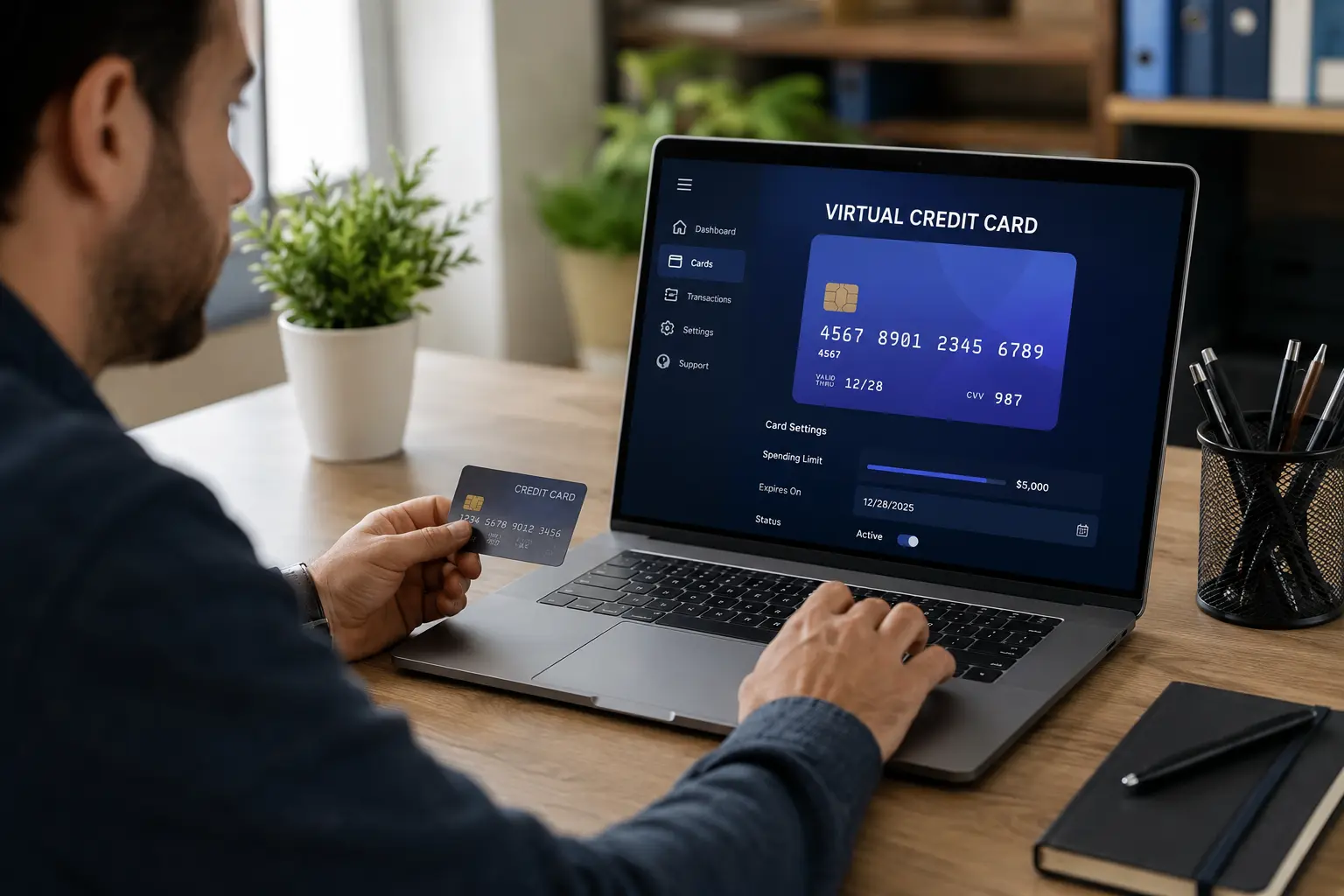
A virtual credit card is a digitally generated payment card that functions just like a physical credit card but exists only in electronic form. Instead of receiving a plastic card in the mail, users receive a unique card number, expiration date, and security code that can be used for online or digital transactions.
Although there is no physical card, the payment network recognizes it exactly like a traditional credit card. Merchants process it using the same payment infrastructure, making virtual cards compatible with millions of businesses worldwide.
Most virtual cards are connected to an existing credit account, while others are funded through business expense platforms, fintech applications, prepaid balances, or corporate payment systems.
One of the biggest advantages is flexibility. Companies can generate cards for a single purchase, recurring subscriptions, specific vendors, individual employees, or projects with customized spending controls.
Why Companies Offer Virtual Credit Cards
Businesses create virtual cards because digital payments require stronger security and better spending control than traditional plastic cards can provide.
Instead of exposing the same permanent card number repeatedly, virtual cards allow unique credentials to be generated for different situations. If one virtual card becomes compromised, it can usually be frozen or deleted without affecting the primary account.
For organizations, virtual cards also simplify expense management. Finance teams can assign individual cards to departments, contractors, or software subscriptions while defining spending limits, merchant restrictions, and expiration dates.
Consumers benefit as well. Shopping online with a virtual card reduces the risk of exposing their primary card number to every website they visit.
The Core Technology Behind Virtual Credit Cards
Many people picture virtual card creation as software randomly generating numbers. In reality, the process involves several connected systems working together within seconds.
When someone requests a virtual card, the provider communicates with multiple financial services before a usable card is created.
The process generally involves:
- The customer account
- Banking partner
- Card issuer
- Payment network
- Tokenization platform
- Fraud detection systems
- Card management software
- Authorization engine
- Secure databases
Each component has a specific responsibility. If any layer fails, the virtual card cannot safely process payments.
This interconnected architecture is what makes virtual cards trusted by merchants around the world.
The Company Verifies the Customer
Before generating any payment credentials, companies must verify that the customer is eligible to receive a virtual credit card.
Depending on the provider, this verification may include identity confirmation, account authentication, fraud screening, risk analysis, and account status checks.
For consumer accounts, the company often verifies:
Identity Verification
The platform confirms that the account belongs to a legitimate customer and meets required verification standards.
Account Standing
Existing credit accounts are checked to ensure they remain active and available for virtual card generation.
Fraud Risk Analysis
Machine learning models evaluate whether the request appears normal or suspicious. Factors may include login history, device information, location consistency, and previous account behavior.
This entire process usually happens automatically within seconds.
A Funding Source Is Assigned
Every virtual credit card needs a funding source before it can approve transactions.
Many people believe virtual cards contain stored money, but that's rarely the case.
Instead, companies connect each virtual card to one of several possible funding methods:
Existing Credit Line
The virtual card uses the available credit from an existing account.
Corporate Spending Account
Businesses often connect virtual cards to centralized company budgets.
Expense Management Platform
Modern finance platforms create virtual cards linked to departmental expense accounts.
Prepaid Balance
Some providers allow users to preload funds before generating virtual cards.
Without a funding source, the card would have no way to authorize purchases.
The Issuer Generates Card Credentials
Once the account has been approved and linked to funding, the issuing system begins creating the virtual card.
This stage is much more complex than generating random numbers.
Every card must comply with global payment standards so merchants recognize it immediately.
The issuer generates several important components.
Card Number
The primary account number follows internationally recognized formatting standards.
Each section of the number has a specific meaning, including issuer identification and account information.
Expiration Date
The issuer assigns a validity period.
Some virtual cards expire after several years, while others remain active only for a few minutes, hours, or a single purchase.
Security Code
A unique verification code is generated alongside the card number.
This helps merchants verify card-not-present transactions.
These credentials are then securely stored inside encrypted payment systems.
The Card Is Registered With the Payment Network
Generating a card number alone does not make it functional.
The issuer communicates with the appropriate payment network so the card becomes recognized during transaction processing.
This registration allows merchants to receive approval requests whenever the virtual card is used.
Without this step, payment terminals and online checkout systems would reject the card because no issuing institution could validate it.
This registration process occurs behind the scenes and typically finishes within moments.
Security Rules Are Applied
One of the most powerful features of virtual credit cards is that companies can customize security before the card is ever used.
Instead of issuing one unrestricted payment card, businesses create rules that automatically control how the virtual card behaves.
Examples include limiting purchases to a specific merchant, setting maximum transaction values, restricting monthly spending, allowing only one successful payment, or automatically deactivating the card after a predefined period.
In my experience testing different financial platforms, this is where virtual cards become especially useful. Creating a dedicated card for a software subscription or an online purchase provides peace of mind because the card can be locked or deleted without disrupting other payments. It also makes budgeting significantly easier since every card serves a single purpose instead of mixing multiple expenses on one account.
These built-in controls help reduce accidental overspending while making unauthorized transactions far less likely to succeed.
By this stage, the virtual credit card has been successfully created. However, generating the card is only half of the story. The next phase is where things become even more interesting—how the card is tokenized, encrypted, authorized in real time, monitored by AI fraud detection systems, and approved within seconds whenever a purchase is made.
In the next part, we'll explore the complete payment flow from the moment you click "Pay Now" until the transaction is either approved or declined, along with the security technologies that protect every step.
What Happens When You Use a Virtual Credit Card?
After a virtual credit card has been generated, the real magic begins when you actually use it to make a payment. Although the entire process usually takes only a few seconds, dozens of security checks and communication steps occur behind the scenes before a transaction is approved.
Understanding this payment flow helps explain why virtual credit cards are considered one of the safest ways to pay online. Every transaction passes through multiple layers of verification, encryption, fraud analysis, and authorization before any money changes hands.
Let's walk through each step in detail.
The Customer Starts a Payment
The payment journey begins when a customer enters the virtual card details during checkout or selects a saved virtual card in a digital wallet or payment platform.
The merchant collects the card number, expiration date, security code, and transaction amount. Additional information such as billing details, device information, browser data, and purchase characteristics may also be gathered to help evaluate the transaction.
From the customer's perspective, the process looks identical to using a physical credit card. Behind the scenes, however, far more security measures are working to protect the payment.
Sensitive Card Information Is Encrypted
Before payment information travels across the internet, it is encrypted.
Encryption converts readable payment data into an unreadable format that can only be interpreted by authorized systems using secure cryptographic keys.
Even if someone were able to intercept the transmitted data, they would see meaningless encrypted information instead of the actual card number.
Modern payment systems rely on strong encryption standards to safeguard sensitive financial data during transmission between the customer, merchant, payment gateway, and issuing institution.
This encrypted communication significantly reduces the risk of payment information being exposed while traveling across networks.
Tokenization Adds Another Layer of Protection
One of the technologies that makes virtual credit cards especially secure is tokenization.
People often confuse tokenization with encryption, but they serve different purposes.
Encryption protects information while it is being transmitted or stored.
Tokenization replaces sensitive payment information with a randomly generated token that has no meaningful value outside the payment ecosystem.
Instead of storing the real card number, many merchants store the token.
If a merchant's database were compromised, attackers would typically obtain unusable tokens rather than actual payment credentials.
This approach dramatically reduces the amount of sensitive card information exposed across payment systems.
During my own research into payment security, tokenization consistently appeared as one of the biggest reasons virtual cards provide stronger protection than traditional payment methods. Because the original card number is rarely shared or stored, the overall attack surface becomes much smaller.
The Payment Gateway Receives the Request
Once the payment information has been encrypted and tokenized where appropriate, it reaches the payment gateway.
The payment gateway acts as the secure bridge between the merchant and the financial institutions responsible for approving the transaction.
Its responsibilities include:
Validating Payment Data
The gateway checks whether the submitted payment information appears complete and correctly formatted before forwarding it.
Secure Transmission
It securely routes the authorization request through the appropriate payment infrastructure.
Initial Risk Screening
Some payment gateways perform preliminary fraud checks before the request reaches the card issuer.
This entire process usually happens in fractions of a second.
The Payment Network Routes the Transaction
After leaving the payment gateway, the authorization request is sent through the payment network associated with the virtual card.
The payment network serves as the communication highway connecting merchants with card issuers.
Rather than approving payments itself, the network identifies the issuing institution responsible for the virtual card and securely forwards the request.
This routing process allows billions of payment requests to reach the correct destination every year while maintaining speed, reliability, and security.
Fraud Detection Systems Analyze the Purchase
Before approval, modern virtual credit card providers perform sophisticated fraud analysis.
Instead of relying on simple rules, many companies use artificial intelligence, machine learning, behavioral analytics, and real-time risk scoring to identify suspicious activity.
A transaction may be evaluated based on dozens or even hundreds of signals, including:
Spending Patterns
Has the customer made similar purchases before?
Merchant Reputation
Is the business known and trusted?
Device Recognition
Is the payment being made from a familiar device?
Login History
Does the account activity match the user's normal behavior?
Transaction Size
Is the purchase unusually large compared to previous activity?
Geographic Consistency
Does the payment appear consistent with recent account activity?
Time-Based Analysis
Is the transaction occurring at an unusual time compared with the customer's normal usage?
These systems calculate a risk score within milliseconds.
If the purchase appears legitimate, processing continues.
If unusual behavior is detected, the transaction may require additional verification or be declined automatically.
Available Credit or Funds Are Verified
Even if a transaction passes fraud screening, the issuer still needs to confirm that sufficient funds or available credit exist.
The authorization system checks several important factors.
Available Spending Limit
Is enough credit available to cover the purchase?
Card Status
Is the virtual card active?
Security Restrictions
Has the card exceeded spending limits or violated any usage rules?
Expiration Validation
Has the virtual card already expired?
Merchant Restrictions
Is the purchase being made with an approved merchant if restrictions exist?
Only after these checks pass can authorization continue.
The Issuer Makes an Approval Decision
The issuing institution now has everything needed to decide whether the payment should proceed.
The authorization engine evaluates all collected information together, including customer verification, available credit, fraud score, spending controls, merchant information, and transaction details.
Possible outcomes include:
Approved
The transaction satisfies all security and financial requirements.
Declined
The payment fails one or more validation checks.
Additional Authentication Required
The customer may be asked to complete another verification step before approval.
The decision is returned almost instantly, creating the seamless checkout experience most customers expect.
How Long Does This Entire Process Take?
Although we've described many individual steps, the complete authorization process is remarkably fast.
In most situations, everything from clicking the payment button to receiving an approval or decline happens in just a few seconds.
This speed is possible because payment providers have invested heavily in high-performance infrastructure capable of processing enormous volumes of secure transactions simultaneously.
Customers experience a smooth checkout, while complex security systems quietly operate in the background.
Why Businesses Prefer Virtual Cards for Expense Management
Beyond online shopping, virtual credit cards have become an essential financial tool for businesses.
Instead of distributing physical cards to every employee, organizations can instantly generate purpose-specific virtual cards with customized spending rules.
For example, a marketing team might receive a dedicated card for advertising expenses, while the software department uses separate virtual cards for cloud subscriptions. Finance teams can monitor each card independently, making reconciliation and budgeting much easier.
From what I've observed, companies often gain more than just stronger security. They also improve visibility into spending, reduce manual reimbursement requests, simplify auditing, and quickly disable cards that are no longer needed. This level of control is difficult to achieve with traditional physical cards.
As organizations continue adopting digital financial tools, virtual cards are becoming a practical solution for managing both security and operational efficiency.
At this point, we've covered how companies generate virtual credit cards and how payments are securely processed from checkout to approval. The final part will explore the technologies, regulations, security standards, common misconceptions, limitations, future innovations, and answer the question many people ask: Can anyone build a virtual credit card platform?
The Technologies That Make Virtual Credit Cards Possible
Virtual credit cards may appear simple on the surface, but they rely on a sophisticated technology stack that keeps every transaction secure, fast, and reliable. Companies invest heavily in modern payment infrastructure to ensure customers can generate and use virtual cards without experiencing delays or security concerns.
Cloud computing allows card issuance systems to scale rapidly as customer demand grows. Secure APIs connect banks, payment processors, fraud detection platforms, and mobile applications so information can move safely between systems. Artificial intelligence continuously analyzes transaction behavior to identify suspicious activity before fraud occurs. Encryption protects sensitive payment information during transmission, while tokenization minimizes the exposure of actual card numbers.
Together, these technologies create an ecosystem where virtual cards can be generated in seconds while maintaining enterprise-grade security standards.
Security Standards Companies Must Follow
Generating virtual credit cards is not simply a technical challenge. Companies must also meet strict security and compliance requirements designed to protect customers and payment networks.
Organizations handling payment information implement comprehensive security practices that include encrypting sensitive data, limiting employee access, monitoring systems around the clock, maintaining detailed audit logs, and performing regular security assessments.
Many providers also conduct penetration testing, vulnerability scanning, disaster recovery planning, and continuous infrastructure monitoring to reduce operational risks.
These security measures help build customer confidence while supporting reliable payment processing at scale.
Can Any Company Create Virtual Credit Cards?
Technically, yes—but not independently.
A company cannot simply build software that generates working credit card numbers. Functional virtual credit cards require partnerships with licensed financial institutions and access to established payment infrastructure.
Most businesses offering virtual cards work with issuing partners that provide the regulated financial framework needed to issue payment credentials legally and securely.
The technology company focuses on customer experience, mobile apps, budgeting features, expense management, analytics, and security tools, while financial partners manage card issuance and transaction processing.
This collaborative approach allows innovative payment products to reach customers without every technology company becoming a licensed financial institution.
Common Misconceptions About Virtual Credit Cards
As virtual cards become more popular, several misconceptions continue to circulate online.
One common myth is that virtual credit cards are anonymous. In reality, legitimate providers verify customer accounts and maintain transaction records to comply with financial regulations.
Another misconception is that virtual cards cannot be traced. Every approved transaction moves through established payment networks, making payment activity fully auditable by the organizations involved.
Some people also believe virtual cards are only useful for online shopping. While e-commerce remains a major use case, many businesses use virtual cards for employee expenses, recurring subscriptions, supplier payments, project budgets, and automated procurement systems.
Finally, many assume virtual cards are completely immune to fraud. Although they significantly reduce risk, no payment method can eliminate fraud entirely. Responsible providers continuously monitor transactions and improve their security systems to stay ahead of emerging threats.
Benefits of Virtual Credit Cards
Virtual credit cards provide meaningful advantages for both individuals and organizations.
For consumers, they reduce the need to share a primary card number with every online merchant, making digital shopping more secure. Temporary or merchant-specific cards also provide greater confidence when purchasing from unfamiliar websites.
Businesses benefit from improved financial oversight. Dedicated cards can be assigned to employees, vendors, departments, or individual projects, making it easier to monitor spending and simplify expense reporting.
Virtual cards also reduce administrative work, improve budgeting accuracy, and allow organizations to react quickly if a card needs to be suspended or replaced.
As digital payments continue to grow, these advantages make virtual cards an increasingly valuable financial tool.
Limitations to Consider
Despite their many benefits, virtual credit cards are not perfect.
Some merchants may still require a physical card for identity verification, especially during certain in-person transactions or service pickups. In other situations, businesses may need the physical card used during booking.
Features also vary between providers. Some platforms support one-time cards, while others offer reusable virtual cards with advanced spending controls. Certain providers allow merchant locking, whereas others focus on general-purpose payments.
Understanding these differences helps users choose the solution that best fits their personal or business needs.
The Future of Virtual Credit Cards
Virtual credit cards continue to evolve as payment technology advances.
Future platforms are expected to deliver even smarter fraud detection, faster payment approvals, stronger biometric authentication, more intelligent spending controls, and deeper integration with digital financial management tools.
Artificial intelligence will likely play a larger role in identifying unusual payment behavior before fraud occurs. Automated budgeting features may create temporary cards for specific purchases without requiring manual setup, while real-time analytics could provide instant insights into personal and business spending.
As digital commerce expands, virtual cards are expected to become an increasingly standard part of secure online payments.
Conclusion
Companies generate virtual credit cards through a sophisticated combination of financial partnerships, secure software, payment networks, encryption technologies, fraud prevention systems, and regulatory compliance. What appears to users as an instant card creation process actually involves numerous coordinated systems working together within seconds.
Rather than generating random numbers, providers create fully authenticated payment credentials connected to legitimate funding sources and protected by multiple security layers. Every transaction undergoes verification, authorization, encryption, and fraud analysis before approval, helping ensure both convenience and security.
Whether used for online shopping, subscription management, employee expenses, or business payments, virtual credit cards offer a practical way to improve payment security while giving users greater control over how and where their money is spent. As technology continues to advance, virtual cards are likely to play an even more significant role in the future of digital payments.
Frequently Asked Questions
How do companies generate virtual credit cards?
Companies generate virtual credit cards by working with licensed financial institutions and payment networks. After verifying the customer and linking a funding source, secure systems create unique card credentials that can process transactions through standard payment infrastructure.
Are virtual credit cards randomly generated?
No. Although every card number is unique, it follows established payment industry standards and is created within regulated card issuance systems rather than through simple random number generation.
Are virtual credit cards safe to use?
Yes. They are generally considered very secure because they use encryption, tokenization, fraud detection, spending controls, and real-time authorization to protect payment information.
Do virtual credit cards have spending limits?
Yes. Many providers allow spending limits based on transaction amount, daily usage, monthly budgets, merchant categories, or individual business policies.
Can businesses create unlimited virtual cards?
Many business platforms allow organizations to generate large numbers of virtual cards, although availability depends on the provider's policies, account type, and risk controls.
What happens if a virtual credit card is compromised?
Most providers allow the affected virtual card to be frozen, deleted, or replaced without impacting the primary funding account, reducing disruption and improving security.
Do virtual credit cards work with recurring subscriptions?
Yes. Reusable virtual cards are commonly used for subscription services because they can remain active while giving users greater control over recurring charges.
Why do companies use tokenization?
Tokenization replaces sensitive card information with secure digital tokens, reducing the amount of actual payment data stored by merchants and lowering the risk of data exposure.
Can startups build their own virtual credit card platform?
Yes, but they typically need partnerships with licensed issuing institutions and payment infrastructure providers. While the software experience can be developed in-house, regulated financial services usually require collaboration with authorized partners.