

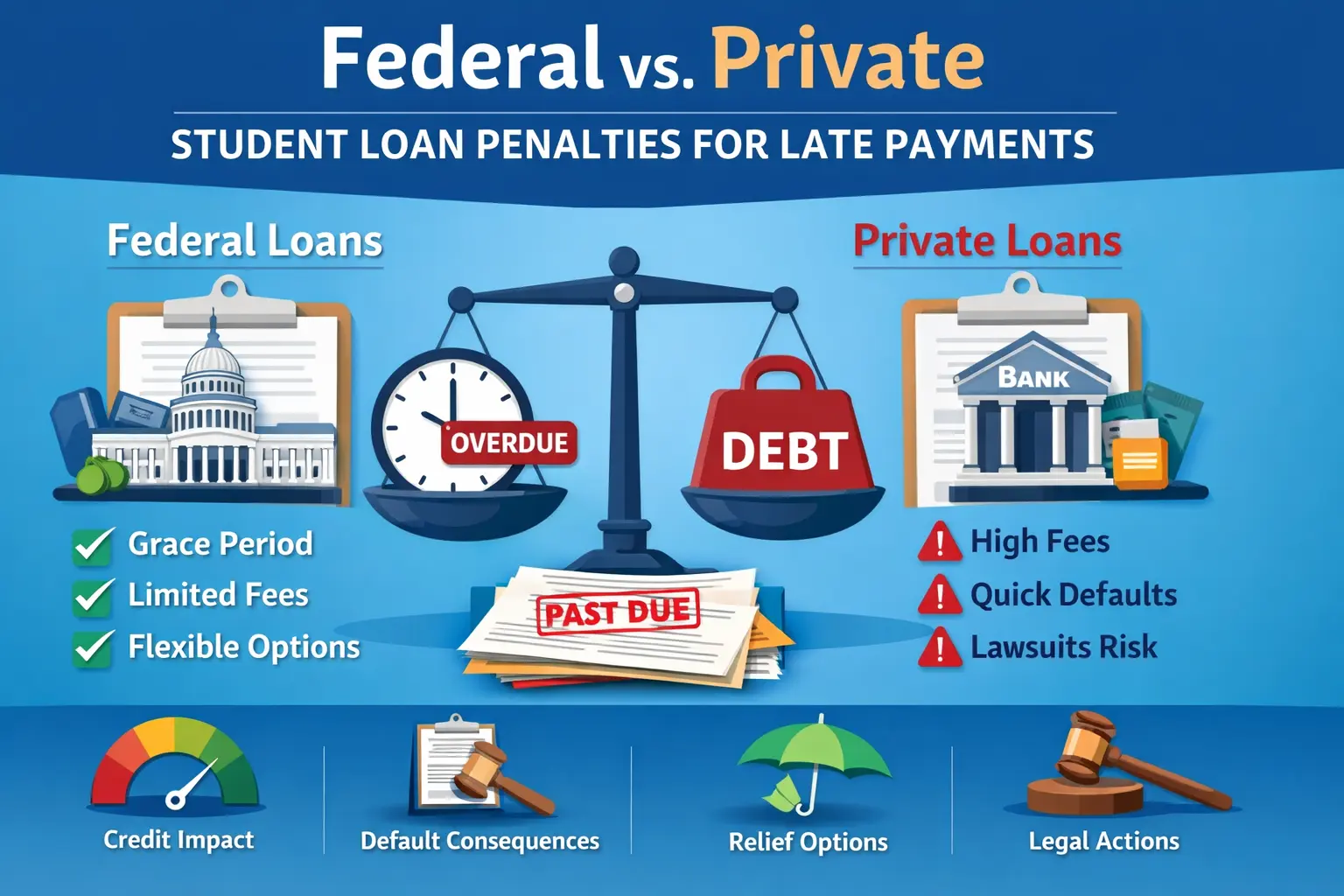
How Does the Punishment for Late Payment of Student Loans Differ Between Federal and Private Loans?
Student loans are often described as “good debt,” but that description quickly falls apart when payments are missed. One late payment can quietly grow into fees, credit damage, or even legal action—depending on the type of loan you have.
Many borrowers assume that all student loans work the same way. From my experience helping borrowers review repayment problems, this is one of the most dangerous assumptions you can make. Federal and private student loans punish late payments in very different ways, and understanding those differences can save you thousands in fees and years of financial stress.
This guide explains—clearly and completely—how late payment penalties differ between federal and private student loans, what really happens behind the scenes, and how to protect yourself if you’re struggling to pay.
Why Late Payments Matter More Than You Think
A late student loan payment isn’t just about missing a due date. It triggers a chain reaction that can affect:
- Your credit score
- Your future borrowing ability
- Your access to repayment relief
- Your legal exposure
I’ve seen borrowers panic after one missed payment, while others ignore months of nonpayment—only to face wage garnishment later. The key difference usually comes down to loan type.
Understanding the Two Types of Student Loans
Before comparing punishments, let’s clearly define the two categories.
What Are Federal Student Loans?
Federal student loans are issued or backed by a public authority. They are governed by standardized rules, borrower protections, and legally required relief options.
Key characteristics:
- Fixed interest rates
- Regulated collection practices
- Mandatory hardship protections
- Multiple repayment and forgiveness options
Private student loans are issued by banks, credit unions, or online lenders. Their rules are set by contracts—not public policy.
Key characteristics:
- Variable or fixed interest rates
- Limited or no hardship protections
- Faster escalation to collections
- Stronger legal enforcement
When Is a Student Loan Considered “Late”?
Federal Loans: A Grace-Based System
Federal loans usually aren’t reported as late immediately.
- Payments are considered late after the due date
- Credit reporting typically begins after 90 days of nonpayment
- Borrowers have time to correct mistakes
- Late fees can apply immediately after the due date
- Credit reporting may begin after 30 days
- No guaranteed warning period
In practice, private loans punish missed payments much faster.
Late Fees: Federal vs Private Student Loans
Federal Student Loan Late Fees
Federal loans are surprisingly forgiving.
- Late fees are capped by regulation
- Fees are usually a small percentage of the missed payment
- Some federal loans charge no late fees at all
- Late fees are set by contract
- Flat fees or percentage-based penalties are common
- Fees can stack month after month
I’ve reviewed private loan statements where late fees alone added hundreds to the balance in a single year.
Credit Score Impact: A Critical Difference
Federal Loan Credit Reporting
Federal loans follow standardized credit reporting rules:
- Late payments appear after prolonged delinquency
- Reporting is consistent and predictable
- Borrowers have time to fix issues
This structure gives borrowers breathing room.
- One missed payment can damage your credit
- Negative marks appear quickly
- Disputes are harder to resolve
If your credit profile matters for housing, business, or refinancing, private loan lateness is especially dangerous.
Delinquency vs Default: How the Paths Diverge
Federal Student Loan Delinquency and Default
Federal loans move slowly—but steadily.
- Delinquency begins after a missed payment
- Default typically occurs after many months of nonpayment
- Borrowers receive multiple notices
Even then, federal loans offer recovery paths.
- Default timelines are shorter
- Lenders may accelerate the full balance
- Legal action can begin quickly
Collection Powers: Who Has More Authority?
Federal Loan Collection Powers:
Federal loans have extraordinary legal authority, including:
- Administrative wage garnishment
- Tax refund interception
- Benefit offsets
However—and this matters—they also offer structured ways to stop these actions.
Private lenders lack administrative powers but compensate through courts.
- Lawsuits for unpaid balances
- Court-ordered wage garnishment
- Asset liens (in some cases)
Once a judgment is issued, options become limited.
Repayment Relief Options for Late Payments
Federal Student Loan Relief Programs
Federal loans provide multiple lifelines:
- Income-driven repayment plans
- Payment deferrals
- Temporary forbearance
- Loan rehabilitation
I’ve personally helped borrowers recover from default using rehabilitation—something private loans simply don’t offer.
Private Student Loan Relief Options
Private loan relief is discretionary.
- Temporary hardship programs (if offered)
- Short-term payment reductions
- Interest-only payments
Approval is never guaranteed and depends on the lender’s policies.
Interest Accumulation After Late Payments
Federal Loans
- Interest accrues at regulated rates
- Capitalization rules are controlled
- Interest growth is slower
Private Loans
- Interest may capitalize aggressively
- Variable rates can increase costs
- Balances grow rapidly after default
Many borrowers underestimate how fast private loan balances can snowball.
Long-Term Financial Consequences
Federal Loans: Long Game Consequences
Federal loan penalties are serious but manageable.
- Credit damage can be repaired
- Repayment plans remain available
- Forgiveness options still exist
- Long-lasting credit damage
- Limited settlement leverage
- Legal judgments remain enforceable
I’ve seen borrowers delay buying homes for years because of unresolved private loan defaults.
why do you think banks will try to sell you credit cards or personal loans.
Real-World Insight: What Borrowers Often Miss
From first-hand experience, here are mistakes borrowers frequently make:
- Assuming private loans offer federal-style protection
- Ignoring lender notices until collections start
- Not reading the original loan contract
- Waiting too long to ask for help
The earlier you act, the more options you retain—especially with private loans.
How to Protect Yourself If You’re Late on Payments
Practical Steps That Actually Work
- Check your loan type immediately
- Contact the lender before default
- Document every conversation
- Explore restructuring options early
- Avoid ignoring collection letters
These steps have helped borrowers regain control more times than I can count.
Which Loan Type Is More Forgiving?
Short answer: Federal student loans.
Long answer: Federal loans punish lateness slowly, predictably, and with recovery options. Private loans punish lateness quickly, contractually, and with limited mercy.
Key Differences at a Glance :
Choose Awareness Over Assumptions
Late student loan payments are stressful—but not all student loans punish you the same way. Understanding the difference between federal and private loan penalties can mean the difference between recovery and long-term financial damage.
If there’s one takeaway from this guide, it’s this:
Federal loans are structured to help you recover. Private loans are structured to protect the lender.
Knowing which rules apply to you puts power back in your hands.
FAQ:
What happens if I miss one student loan payment?
For federal loans, usually very little at first. For private loans, late fees and credit damage may start quickly.
Can late payments be removed from my credit report?
Sometimes. Federal loan servicers are more flexible. Private lenders rarely remove accurate late marks.
Do private student loans offer forbearance?
Some do, but it’s optional and often short-term.
Is default worse on federal or private loans?
Private loan default is often harder to recover from due to lawsuits and limited relief options.
Can I negotiate private student loan penalties?
Occasionally, especially before default—but leverage decreases over time.
Should I prioritize paying private loans first?
In many cases, yes—because penalties escalate faster.