
For years, I thought my problem was that I was bad at budgeting. I'd download a budgeting app, spend a few days getting everything organized, and feel pretty good about myself. Then real life would happen.
A friend would invite me to dinner. My car would need a repair. Something I'd been putting off suddenly needed to be replaced. Or I'd see a sale on something I had convinced myself I "needed."
By the end of the month, the carefully planned budget was gone.
For a long time, I thought I needed more discipline.
Eventually, I realized I had been making the same mistake over and over: I was creating budgets for an imaginary version of my life.
That version never had unexpected expenses. It never wanted to go out. It never bought birthday gifts, paid an annual bill, or had a bad month.
That's not a realistic budget.
A realistic budget has to work during an ordinary month—not just a perfect one.
Here's what finally helped me create a budgeting system I could actually stick with.
Start by Tracking Your Spending
Before cutting expenses, changing savings goals, or downloading another budgeting app, I spent one month simply watching where my money was going.
I didn't try to be perfect.
I didn't tell myself I couldn't order takeout or buy coffee.
I just paid attention.
That month taught me more about my spending habits than most of the budgeting advice I'd read before.
I discovered three subscriptions I had completely forgotten about. One was for an app I hadn't used in more than a year.
I also noticed something else: small expenses were adding up faster than I realized.
A coffee here.
A delivery fee there.
A few convenience purchases during the week.
None of them felt significant when I made them. But by the end of the month, those small purchases had added up to a surprisingly large amount.
A simple first step
Open your bank or credit-card statement from last month and go through every transaction.
Ask yourself:
- What was this purchase?
- Did I actually need it?
- Did I choose it intentionally?
- Was it a recurring expense?
- Would I make the same purchase again?
You don't have to eliminate everything you don't need.
The goal is simply to understand where your money is going before deciding where it should go.
Build a Budget Around rule
One of the most popular budgeting ideas is the 50/30/20 rule:
- 50% for needs
- 30% for wants
- 20% for savings and debt repayment
It can be a useful starting framework.
But it's not a rule that every household can realistically follow.
If housing costs take up a large portion of your income, forcing your spending into an exact percentage can make budgeting feel like a test you're constantly failing.
Instead, start with your actual numbers.
List your:
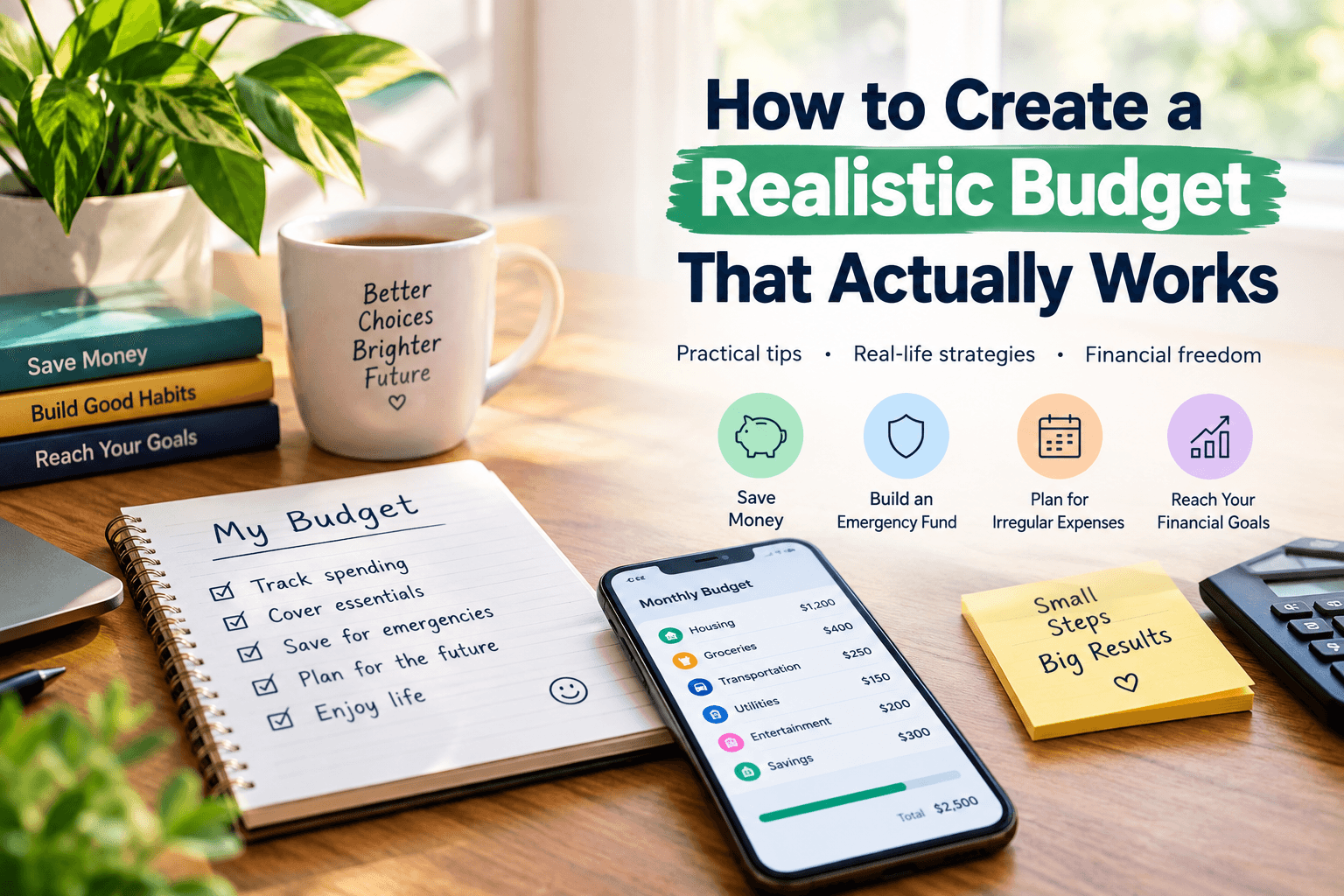
- Housing costs
- Utilities
- Groceries
- Transportation
- Insurance
- Debt payments
- Subscriptions
- Healthcare expenses
- Entertainment
- Savings
- Other recurring expenses
Then look at what's left.
The important question isn't whether your budget looks like somebody else's.
It's whether you know where your money is going and whether those choices match your priorities.
Give Yourself Room for Fun
This was one of the biggest changes I made.
I used to treat entertainment and small pleasures as the first things that had to disappear whenever I created a budget.
That approach usually lasted a few weeks.
Then I'd get frustrated, spend more than planned, and eventually abandon the entire budget.
A better approach was giving myself a specific amount of money I could spend without feeling guilty.
It might be money for restaurants, coffee, hobbies, entertainment, or whatever you personally enjoy.
The amount matters less than the idea.
A budget shouldn't make every purchase feel like you've done something wrong.
If your plan is so restrictive that you can't imagine following it for an entire year, it's probably too restrictive.
Start Your Emergency Fund Small
For years, I ignored emergency savings because the advice to save three to six months of expenses sounded impossible.
If you don't have much money left at the end of the month, hearing save six months of expenses doesn't necessarily motivate you.
It can have the opposite effect.
You might decide the goal is impossible and save nothing.
A smaller first target can make more sense.
For example, you might start with a $500 emergency fund.
That's not enough to replace several months of income, but it can help with smaller emergencies such as:
- A car repair
- An unexpected medical or dental bill
- A broken appliance
- An urgent home expense
- An unexpected travel expense
Once the first target is reached, you can gradually build toward a larger emergency fund.
The important part is getting started.
Automatic Your Savings
The budgeting change that made the biggest difference for me wasn't another spreadsheet.
It was automation.
I set up an automatic transfer to a separate savings account around payday.
That meant I didn't have to make the decision every day.
If money stays in your checking account long enough, it's easy to start thinking of it as money available to spend.
Automation changes that.
Instead of saving whatever happens to be left at the end of the month, you're moving some money toward your goal before you have the opportunity to spend it.
Even a small automatic transfer can help create the habit.
As your income or circumstances change, you can adjust the amount.
Don't Forget Irregular Expenses
This is one of the easiest budgeting mistakes to make.
Some expenses don't happen every month, so they don't feel like monthly expenses.
Then they arrive and suddenly feel like an emergency.
Think about expenses such as:
- Car registration
- Annual insurance payments
- Holiday gifts
- Property or vehicle expenses
- Annual memberships
- School expenses
- Home maintenance
- Birthdays and special occasions
Suppose you know you'll spend $600 on an annual expense.
Instead of waiting for the bill to arrive, you could set aside about $50 per month.
When the expense arrives, the money is already waiting for it.
This is sometimes called a sinking fund.
It turns an "unexpected" expense into a planned expense.
Cut Expenses Without Making Life Miserable
Most budgeting advice eventually says something like:
"Stop buying coffee."
Maybe that works for some people.
But eliminating every small thing you enjoy isn't necessarily the best way to reduce spending.
I found it more useful to look for expenses that had little impact on my quality of life.
For example, review your recurring bills.
You might find:
- A subscription you no longer use
- A phone plan with features you don't need
- An internet plan that could be cheaper
- Insurance that is worth shopping around
- Streaming services you rarely watch
- Apps or memberships you forgot about
Sometimes one phone call can save more money than months of trying to eliminate every small pleasure.
It's also worth reviewing subscriptions once every few months.
Recurring charges are easy to ignore because each individual payment may seem small.
Reduce Food Delivery Before Eliminating Restaurants
Food spending can be another area where small changes add up.
That doesn't necessarily mean never eating at restaurants.
For example, if someone orders delivery four times a week, reducing it to once a week could make a much bigger difference than obsessing over a $3 coffee.
Delivery fees, service fees, tips and higher menu prices can make frequent delivery considerably more expensive than cooking at home.
The goal isn't to eliminate restaurants.
It's to identify the version of the habit that's costing you the most.
Check Your Budget Once a Week
I used to check my bank balance every day.
Instead of making me feel more in control, it made me anxious.
Eventually, I switched to a short weekly money check-in.
It takes around ten minutes.
During that check-in, I look at:
- What I spent during the week.
- Whether any bills are coming up.
- How much is left in each spending category.
- Whether I need to adjust anything for the following week.
Then I do a longer review at the end of the month.
That rhythm works better for me than constantly checking my accounts.
You don't need to think about your budget every hour for it to work.
You need a system you can consistently maintain.
What Small Changes Can Add Up To
The interesting thing about budgeting is that you don't always need one dramatic change.
Several small changes can produce a meaningful difference.
For example, imagine someone finds:
- $25 per month in forgotten subscriptions
- $15 per month by negotiating a phone or internet bill
- $180 per month by reducing frequent food delivery
That's $220 per month.
Over a year, that's $2,640.
The exact numbers will obviously be different for everyone.
The point is that budgeting doesn't always require one huge sacrifice.
Sometimes it's several boring, ordinary changes that quietly add up.
How Much Should You Save Each Month?
There's no single percentage that works for every person.
Twenty percent of income is often used as a budgeting guideline, but someone's ability to save depends on income, housing costs, debt, family responsibilities, location and other expenses.
If 20% isn't realistic right now, that doesn't mean saving is pointless.
Saving 5% or 10% consistently can be more sustainable than setting an aggressive target that causes you to give up after a few months.
Start with an amount you can realistically maintain.
Then increase it when your financial situation improves.
What If Your Income Changes Every Month?
A fixed monthly budget can be difficult when income isn't consistent.
If your income changes from month to month, one approach is to build your basic budget around a conservative income number rather than your best month.
For example, if your monthly income has recently ranged from $2,500 to $3,500, you might build your essential spending plan around the lower end rather than assuming you'll earn $3,500 every month.
Then you can give the extra income a job when it arrives.
Depending on your situation, that could mean:
- Building emergency savings
- Paying down high-interest debt
- Saving for a planned expense
- Increasing retirement contributions
- Covering future irregular expenses
The exact priorities depend on your circumstances.
The important idea is not to build a lifestyle around your highest-earning month.
Should You Save or Pay Off Debt First?
This is another question where a one-size-fits-all answer doesn't work.
If you have no emergency cushion at all, building a small starter fund can provide some protection against having to use new debt when something unexpected happens.
After that, high-interest debt can become an important priority because interest can make balances much more expensive over time.
Once expensive debt is under control, you can put more of your attention toward longer-term savings and other financial goals.
The right order can vary depending on the type of debt, interest rate, employer benefits, income stability and other factors.
Common Budgeting Mistakes to Avoid
Making the budget too strict
If your budget leaves no room for anything enjoyable, you're more likely to abandon it.
Forgetting irregular expenses
Annual and occasional expenses can destroy an otherwise good monthly budget if you don't plan for them.
Copying someone else's numbers
Your housing costs, income, transportation and family situation may be completely different from someone else's.
Treating one bad month as failure
Unexpected expenses happen.
A bad month doesn't automatically mean your budgeting system failed.
Look at what happened, adjust the plan, and continue.
Focusing only on cutting expenses
Reducing unnecessary spending matters, but increasing income can also change the equation.
A budget should help you manage money—not simply find more things to stop buying.
A Simple Budgeting System
If you want to start without making things complicated, try this:
Step 1:
Track everything you spend for one month.
Step 2:
Separate essential expenses from optional spending.
Step 3:
Identify recurring expenses you no longer need.
Step 4:
Create categories for irregular expenses.
Step 5:
Choose a small emergency-fund target.
Step 6:
Automate a realistic savings amount.
Step 7:
Give yourself a reasonable amount for fun.
Step 8:
Review your spending once a week.
Step 9:
Review the entire month before creating the next month's plan.
Step 10:
Adjust the budget instead of abandoning it when something goes wrong.
The Goal Isn't a Perfect Budget
The biggest lesson I learned is that budgeting isn't really about restriction.
It's about awareness.
Before I started budgeting seriously, money seemed to disappear.
Now I have a much better idea of where it goes, what expenses are coming, how much I can comfortably spend, and what I'm trying to save for.
My budget still isn't perfect.
Some months cost more than others.
Unexpected expenses still happen.
I still spend money on things I don't strictly need.
But that's the point.
A useful budget doesn't require you to become a completely different person.
It needs to work for the person you actually are.
The goal isn't to create a perfect spreadsheet.
The goal is to create a financial system that can survive a normal, imperfect month.
And that's the kind of budget that's much easier.