
How to Invest 10K and Make Money: A Practical Guide for Growth
Having ten thousand dollars sitting in a bank account can feel like both an opportunity and a burden. It's enough money to genuinely change your financial trajectory, yet not so much that a mistake won't sting. I remember the first time I had a five-figure sum to invest — I spent nearly three weeks reading forums, comparing brokers, and second-guessing every decision before I finally put a single dollar to work. Looking back, that hesitation cost me more than any bad investment would have. This guide walks through exactly how to approach investing 10,000 dollars, based on strategies that actually hold up once market volatility kicks in.
What Makes 10K Such a Useful Starting Point
Ten thousand dollars sits in a sweet spot. It's substantial enough to diversify across several asset classes, qualify for better account tiers at most brokerages, and generate returns that are actually noticeable rather than negligible. At the same time, it's small enough that you can afford to take calculated risks with a portion of it while keeping the rest protected.
Most people treat this entire sum as one single decision, and that's usually where things go wrong. Ten thousand dollars works far better when it's broken into purpose-driven buckets, each one carrying its own timeline and its own tolerance for risk.
Before You Invest a Single Dollar
Two things need to be settled first, and skipping them is one of the more common regrets I hear about.
High-interest debt comes first. If you're carrying credit card balances or personal loans above 8-10% interest, paying those down produces a better guaranteed "return" than the market will. No investment reliably beats a 22% credit card rate, so that debt should disappear before anything gets invested.
Then there's the emergency fund — three to six months of essential expenses, sitting in a high-yield savings account, completely separate from whatever you plan to invest. This isn't just a technicality. It's what stops you from having to sell investments at a loss the moment an unexpected car repair or medical bill shows up. I learned this one the hard way early on, when a sudden expense forced me to sell shares during a dip simply because I hadn't kept a proper cushion.
Once both of those are handled, the full 10K is ready to go to work.
what finance jobs make the most money
Matching Your Timeline to the Right Assets
Your investment horizon changes everything about how this money should be allocated. Money you'll need in two years has no business sitting in the same type of asset as money you won't touch for twenty.
- Short-term (1-3 years): capital preservation matters most here — think high-yield savings accounts, money market funds, and short-term government bonds.
- Medium-term (3-7 years): a balanced mix of bonds and diversified equity funds tends to work well.
- Long-term (7+ years): equities, particularly low-cost index funds, have historically delivered the strongest growth, simply because there's enough time to ride out the downturns.
If there's one rule worth remembering, it's this: the sooner you'll need the money, the more boring the investment should be.
Building the Core: Index Funds and ETFs
For most people, low-cost, broadly diversified index funds or exchange-traded funds form the real backbone of a smart portfolio. Instead of trying to pick individual winning stocks — something even professional fund managers struggle to do consistently — these funds spread your 10K across hundreds or thousands of companies in one move.
A globally diversified core usually includes:
- a broad domestic equity index fund
- an international equity index fund for geographic diversification
- a bond index fund, weighted according to your risk tolerance and timeline
Something that made a real difference for me personally: automating contributions, even small ones, every month rather than trying to time the "perfect" entry point. Markets are unpredictable in the short run, and dollar-cost averaging takes the emotional guesswork out of the equation entirely.
Don't Skip Tax-Advantaged Accounts
Before a standard brokerage account enters the picture, it's worth checking whether you have access to tax-advantaged retirement accounts. These shelter your investment growth from taxes, either now or down the road, and that shelter compounds significantly over time.
If your employer offers matching contributions on a retirement account, capturing the full match first is essentially a guaranteed return — often better than anything else on this list. Once that's secured, an individual retirement account is usually the next stop, with a taxable brokerage account picking up anything beyond those limits.
A Smaller Slice for Higher-Growth Ideas
Once the diversified core is in place, some investors set aside a smaller portion of their 10K for higher-growth or alternative opportunities. Generally, this shouldn't exceed 10-20% of the total, since it carries meaningfully more risk than the core.
A few options worth knowing about: individual stocks can be rewarding if you enjoy researching companies, though they should never replace the diversified core. Real estate investment trusts offer exposure to property markets without the hassle of owning physical real estate, and many pay attractive dividends. Robo-advisors suit people who want a hands-off approach — they build and rebalance a portfolio automatically based on your risk profile for a modest fee. And for the short-term bucket specifically, high-yield savings accounts or CDs remain reliable, low-drama choices that protect your principal while still earning something.
Mistakes That Quietly Undo Good Plans
Talking with other investors over the years, and making a fair share of my own missteps, a few patterns keep showing up.
Chasing recent performance is a tempting trap — a fund or stock that did well last year isn't guaranteed to repeat it. Past returns are one data point, not a forecast.
Fees get ignored far too often. A 1% annual management fee sounds small on paper, but it compounds into a real drag on returns over decades, so the expense ratio deserves a look before any fund gets chosen.
Panic selling during downturns tends to lock in exactly the losses a patient investor would have recovered from. Markets fluctuate; that's not new information, and it shouldn't be treated as one.
Overconcentration is another quiet risk — putting a large share of 10K into a single stock or sector, however promising it looks, exposes the entire portfolio to unnecessary danger.
And rebalancing gets neglected more than people expect. As some assets grow faster than others, your original allocation drifts. A check-in once or twice a year, nudging things back toward your target mix, keeps that risk in check.
Putting the Pieces Together
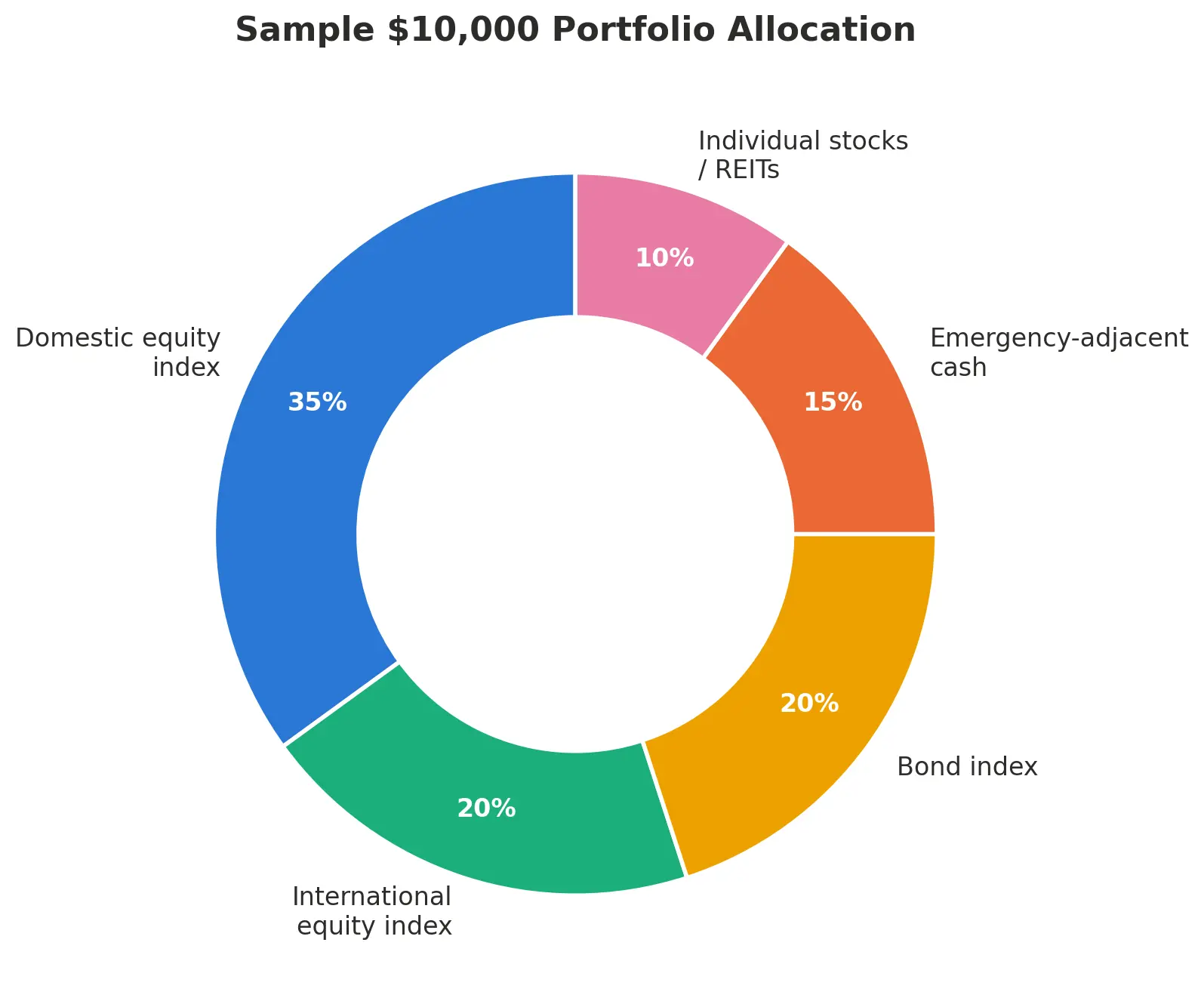
The right split depends entirely on individual circumstances, but a commonly referenced framework for a long-term-focused 10K might look something like this: a portion held in an emergency-adjacent, low-risk account for near-term flexibility; the bulk allocated to diversified index funds spanning domestic and international equities; a smaller slice in bonds to smooth out volatility; and, for those comfortable with extra risk, an optional allocation to individual stocks, REITs, or similar higher-growth ideas.
It isn't a one-size-fits-all formula. It's simply an illustration of matching each portion of your money to a specific goal and timeline, rather than treating the full sum as a single bet.
Staying the Course Once the Plan Is Set
Something rarely mentioned in guides like this one is just how much patience the whole process demands. The first year after committing a lump sum like 10K often feels uneventful — balances shift slightly day to day, and growth doesn't feel dramatic at all. That quiet stretch is normal, and it's usually a sign the plan is working rather than a signal to change anything. Checking a portfolio too often tends to create anxiety rather than insight, which is why many experienced investors deliberately limit themselves to a monthly or quarterly review instead of a daily one.
It also helps to revisit the plan after real life changes — a new job, a move, a shift in income — rather than after every market headline. Headlines happen constantly; a well-built 10K portfolio shouldn't need adjusting every time one appears. The goal is a strategy sturdy enough to keep working quietly in the background while you get on with everything else.
Ten thousand dollars, invested thoughtfully today, has the potential to look very different a decade from now — not because of a lucky pick or perfect timing, but because of a plan simple enough to actually stick with. The investors who look back proudly on this stage of their journey are rarely the ones who found a shortcut. They're the ones who built something steady, stayed with it through the quiet months and the shaky ones alike, and let time turn one decision into something much bigger.
Questions People Often Ask
Is 10,000 dollars enough to start investing seriously? Yes. It's enough to build a genuinely diversified portfolio across multiple asset classes, and many brokerages have no minimums that would stop you from starting with this amount.
Should the whole 10K go in at once, or spread out over time? Both approaches have their merits. Investing it all at once has historically outperformed spreading it out in most market conditions, mainly because markets rise more often than they fall. That said, spreading contributions over several months can ease the emotional weight and reduce the risk of putting everything in right before a downturn.
How much can I realistically expect to earn? It depends heavily on the asset mix and time horizon involved. Diversified equity portfolios have historically delivered solid long-term average annual returns, though any single year can swing significantly in either direction, including negative ones.
Is a financial advisor necessary to invest 10K? Not really. Plenty of people manage their own diversified portfolios successfully using low-cost index funds. An advisor can add value in more complex situations, but simple, disciplined investing generally doesn't require one.
What's the biggest risk at this amount of money? It's rarely the market itself — it's behavior. Panic selling, chasing trends, or leaving the money uninvested out of fear of making a mistake usually causes more damage than any single downturn ever could.