
The Ultimate Income Saving Plan how to Building Financial Security in 2026
An income saving plan is not just about putting leftover cash into a bank account at the end of the month. It is a deliberate, structured system that ensures you allocate a specific portion of your earnings toward future goals before life’s expenses consume everything. If you have ever wondered why your paycheck disappears faster than you expect, or why building wealth feels impossible despite a decent salary, the missing piece is almost always a formalized saving strategy. I learned this the hard way after years of earning well but having nothing to show for it. The moment I switched from random saving to a rule-based system, my financial stress dropped significantly, and my net worth began growing consistently. This guide will walk you through exactly how to build that system for yourself.
What Is an Income Saving Plan and Why Do You Need One?
An income saving plan is a predetermined framework that dictates how much of your earnings you will save, where those savings will go, and what financial goals they will serve. Without this structure, money flows out through unchecked spending, impulse purchases, and lifestyle inflation. Research consistently shows that individuals who follow a written saving plan save roughly twice as much as those who do not. The reason is psychological: when saving becomes a non-negotiable line item rather than an afterthought, your behavior adapts. You stop asking, “Can I afford to save?” and start asking, “How do I align my spending with my savings target?” That shift in mindset is the foundation of long-term wealth.
How Much of Your Income Should You Actually Save?
The standard recommendation is to save at least 20% of your gross monthly income, though the ideal percentage depends on your age, goals, and current financial obligations. If you are starting late or aiming for early financial independence, pushing that figure to 30% or even 40% may be necessary. The key is not to fixate on a universal number but to establish a baseline that is aggressive yet sustainable.
Table
From my own experience, I started with 15% when my income was moderate and gradually increased it by 2% every time I received a raise. This incremental approach prevented lifestyle inflation and allowed me to reach a 35% savings rate without ever feeling deprived.
What Are the Most Effective Income Saving Strategies That Actually Work?
Not all saving methods work for every personality or financial situation. You need a strategy that aligns with your cash flow, discipline level, and goals.
The 50/30/20 Rule vs. The 70/20/10 Method
The 50/30/20 rule allocates 50% of income to needs, 30% to wants, and 20% to savings. It is excellent for beginners because it is simple and forgiving. However, if you live in a high-cost urban area or have significant debt, 20% may feel impossible. In that case, the 70/20/10 method—where 70% covers all living expenses, 20% goes to savings, and 10% to debt repayment or investments—offers more flexibility. I personally used a hybrid version: 50% needs, 20% wants, and 30% savings until I built my emergency fund.
Pay Yourself First: The Automated Approach
Automation is the single most powerful tool in any income saving plan. The strategy is straightforward: on the day your salary hits your account, an automatic transfer moves your predetermined savings into a separate account before you pay any bills or make any purchases. When I implemented this, I stopped treating saving as optional. My checking account only showed spendable money, which naturally constrained my lifestyle without requiring constant willpower.
The Envelope System for Discretionary Spending
For variable expenses like dining out, entertainment, and shopping, the envelope system remains highly effective even in a digital age. You allocate a fixed cash amount or create dedicated digital envelopes for each category. Once the envelope is empty, spending stops. I used a digital version of this for six months and was shocked to discover I was overspending on subscriptions and takeout by nearly $400 monthly. That realization alone funded a significant portion of my investment account.
How Can You Save Money When Living Costs Keep Rising?
Inflation and rising housing costs make saving feel like swimming against a current. The trick is not to rely solely on cutting small pleasures but to attack the largest fixed expenses in your budget.
Negotiating Fixed Expenses
Most people assume rent, insurance premiums, and utility rates are non-negotiable. They are not. When my auto insurance renewal jumped 18%, I spent 45 minutes comparing quotes and negotiating with my provider. The result was a 12% reduction and a $280 annual saving. Similarly, calling your internet or mobile provider and mentioning competitor rates often unlocks loyalty discounts. These are not one-time wins; they permanently reduce your monthly outflow.
The 24-Hour Rule for Big Purchases
Impulse purchases over $100 are one of the biggest leaks in any budget. I instituted a personal rule: any non-essential purchase over that threshold requires a 24-hour cooling-off period. In nine out of ten cases, the desire fades, or I find a better alternative. This single habit has saved me thousands over the years and has eliminated buyer’s remorse entirely.
Where Should You Keep Your Savings for Maximum Growth?
Not all savings should sit in a standard checking account earning negligible interest. Different goals require different vehicles.
Table
I keep my emergency fund in a high-yield savings account separate from my main bank to reduce temptation. My long-term savings go into low-cost index funds. The separation ensures I never accidentally dip into retirement money for a short-term need.
What Are the Biggest Mistakes People Make With Their Saving Plan?
Saving Without a Goal
Vague intentions like “I should save more” almost always fail. Your income saving plan needs specific, measurable targets. Instead of saying, “I want to save for a house,” define it as, “I will save $60,000 for a down payment within 36 months.” When I attached numbers and deadlines to my goals, my commitment transformed from abstract to concrete.
Ignoring High-Interest Debt
Carrying credit card debt at 20% APR while earning 4% in a savings account is mathematically irrational. If you have high-interest debt, your first priority should be eliminating it aggressively, even if it temporarily reduces your savings rate. I paused my investment contributions for eight months to clear a lingering credit card balance, and the $1,200 I saved in interest that year far exceeded any market return I would have earned.
Lifestyle Inflation Traps
Every raise does not need to fund a lifestyle upgrade. When I moved from a $50,000 salary to $75,000, I maintained my previous spending level for a full year. That decision allowed me to max out my emergency fund and start a travel fund simultaneously. The temporary discipline created permanent financial breathing room.

How Do You Stay Consistent With Saving When Motivation Fades?
Motivation is unreliable. Systems are not. The most successful savers I know do not rely on willpower; they rely on architecture.
First, schedule monthly financial reviews. I spend 30 minutes on the first Sunday of each month tracking my progress, adjusting categories, and celebrating small wins. Second, build in micro-rewards. For every three months I hit my savings target, I allocate a small percentage to a guilt-free experience fund. This prevents burnout. Third, find an accountability partner. Discussing money goals with a trusted friend or partner creates social pressure that reinforces discipline.
Can You Build Wealth on a Modest Income?
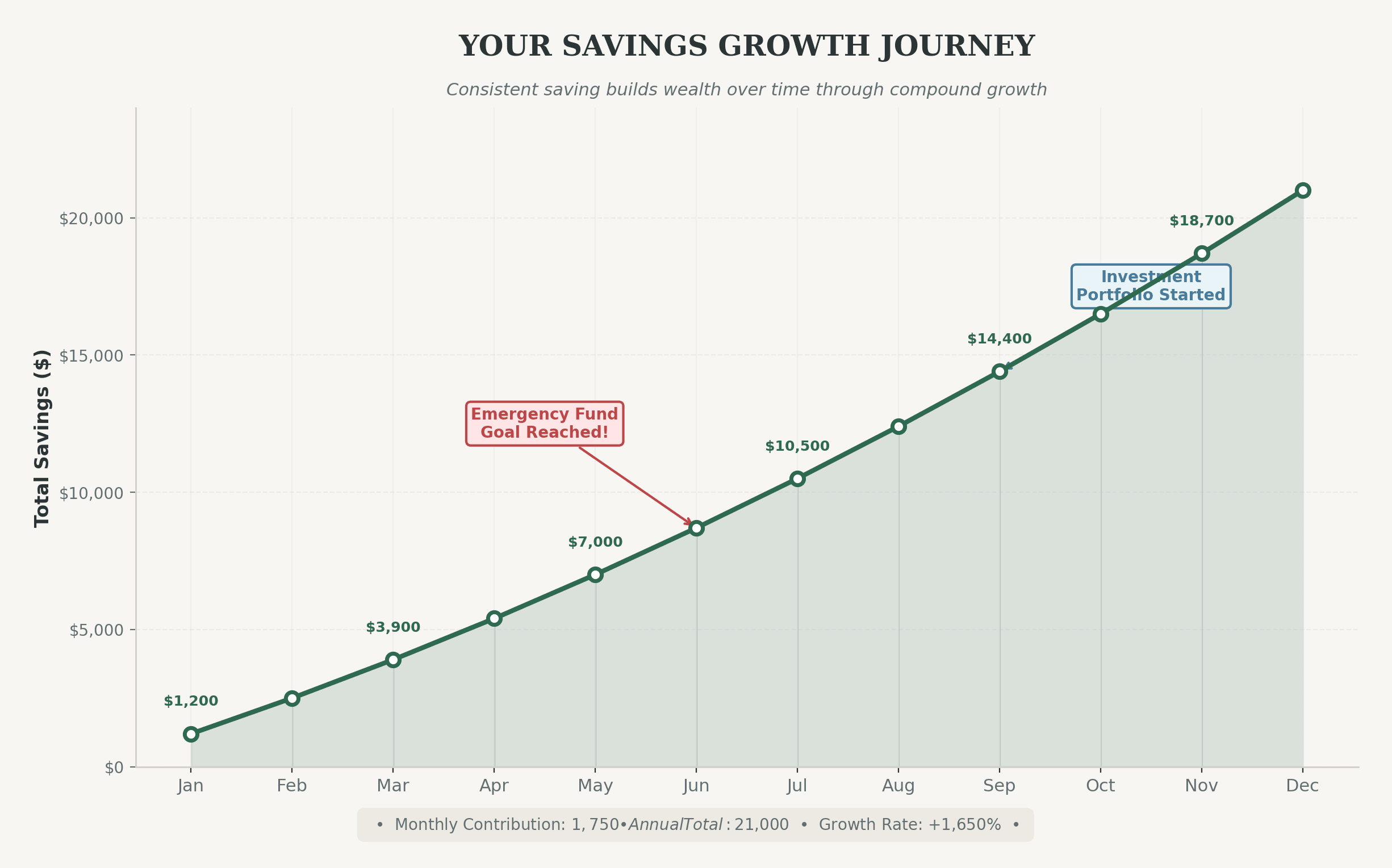
Yes, absolutely. Wealth is a function of your savings rate, not just your income level. A person earning $40,000 annually and saving 25% will accumulate more over time than someone earning $100,000 and saving 5%. The math is unforgiving but fair. What matters most is consistency, time, and the power of compound growth. When I started my career, my income was modest, but I prioritized saving 20% from my very first paycheck. Those early contributions have grown substantially through compound interest. Starting small but starting early beats waiting for the perfect income level.
Your Income Saving Plan Starts Today
Building an effective income saving plan is not about perfection; it is about progress. You do not need a massive salary, complex spreadsheets, or insider financial knowledge. You need a clear target, an automated system, and the discipline to protect your future self from your present impulses. Begin by calculating your current savings rate. If it is zero, commit to 5% this month. If it is 10%, push for 15%. Open that separate high-yield account, automate the transfer, and define your first concrete goal. The best time to start was years ago. The second-best time is right now. Your future financial security is built one deliberate decision at a time.